
HERMES Tribute and Moments of Trip

Trip: 7 September 2022. From Igoumenitsa to Corfu, with the HERMES of Kerkyra Seaways.
The conventional ferry HERMES was built in 1997 in Japan, as the FERRY TSURUGI for the Japanese company Nankai Ferry. She was deployed on the Wakayama-Komatsushima line on the Kii Channel. In 1999 she was transferred to the newly-established Japanese company Rinku Ferry, which had taken the delivery of her sister ship, namely the FERRY KATSURAGI. Both ships were deployed on the Izumisano-Tokushima line on the Osaka Bay, but their service lasted only a season due to the financial issues of Rinku Ferry. As a result, they joined Nankai Ferry in 2000, with the FERRY TSURUGI hence operating once again for her original owners. She was deployed on the Wakayama-Tokushima line, where she remained until 2019. Later in that same year, she was sold to the Greek company Kerkyra Seaways. The latter has been based in Corfu, having been previously known as S&L Ferries (with the name being based after the initials of the Souliotis and the Laïnas families, which have been operating ships together for more than four decades). Having started operations in 1973, they operated several well-known landing craft on the Igoumenitsa-Corfu line, as well as two conventional ferries, namely the PANTOKRATOR from 1996 to 2012 (with that ship having seen been sold to the Indonesian company Panca Merak Samudera PT, where she still operates as the KM PANTOKRATOR) and later the ARITI for a very brief spell from 2007 to 2008, after which they sold her to the Croatian company Jadrolinija (for whom she continues to operate as the KORČULA). By 2019, the company had three ships (one double-ended ferry and two landing craft), and they were part of the Corfu Ferries joint venture together with Gerontakis Shipping, having teamed-up with the latter the previous year in order to maintain a competitive level against the expanding Kerkyra Lines (which was also part of the Kerkyra Ferries joint venture together with the double-ended ferry ANO CHORA II of 2way Ferries, which is widely regarded as one Corfu's best ships). Needing to match the services provided by the latter, S&L Ferries was rebranded as Kerkyra Seaways, and following the completion of the 2019 season they sold one of the two landing craft, namely the NIREAS, to Agioreitikes Grammes (for whom she began service on the Agion Oros area as the PANAGIA EGGYÏTRIA). With that sale, they decided to take a further step by buying a larger conventional ferry, which would become their main asset in Corfu. To that end, they bought the FERRY TSURUGI, which was renamed HERMES. Becoming the first conventional ferry of the company since the departure of the PANTOKRATOR in late 2012, she arrived in Greece in 2020, and she was converted in Salamina and then in Drapetsona, eventually entering service on the Igoumenitsa-Corfu line on the Ionian Sea in 2021.
In just two seasons, the HERMES established herself as the best ship in Corfu, being the most modern and the fastest ferry currently operating on the Igoumenitsa-Corfu line. While her overall appearance did not change dramatically compared to what it was when she was still in Japan, her indoor areas give passengers the chance to enjoy a comfortable trip with a modern touch, and her speed is truly what makes her stand out compared to the veteran landing craft of the service. Indeed, while these ships take 90 minutes to sail between Igoumenitsa and Corfu, the HERMES heads from Igoumenitsa to Corfu, and vice versa, under only one hour and 15 minutes, therefore 15-20 minutes quicker. Being the flagship of Kerkyra Seaways, she also distinguishes herself from the rest of the company's fleet by being the only ship to sail under a red livery (which is aligned with the new logo that the company had released upon rebranding themselves in 2019). This in contrast to the other ships (which also include the three landing craft of Gerontakis Shipping, which were transferred to Kerkyra Seaways in 2020), which feature a dark-blue livery instead. As such, she is easily recognisable, and her amenities and speed have made her the favourite ship of the Corfiots that travel to and from Igoumenitsa on a regular basis.
In addition to being the top ship operating on the Igoumenitsa-Corfu line, the HERMES also became a ship that I would never forget, as she is the one that took me to Corfu for the first time in my life. This has much of a sentimental value for me, as this island is the one from where my family from my father's side hails, with many of my ancestors having lived there during the 18th century up until the early 20th century. Despite my roots from Corfu, I had never been to the island before, instead with my family we would head to Zakynthos for our summer vacation on the Ionian Sea, with the latter island being preferred by late grand-parents who built a house there during the 1970s. We never had the chance to visit Corfu when I was a child, and finally the opportunity presented itself when I had two additional months following my summer vacation to enjoy Greece before I started working. I therefore decided to explore the island at last, passing first by Preveza for a two-night stay at a friend's house, before heading to Igoumenitsa on 7 September 2022. I took the time to explore the city's port before eventually embarking onboard the HERMES. Besides her being the first ship that I used to head to Corfu, she was also the first ship of Kerkyra Seaways with which I traveled, and my trip with her was the first one that I did while sailing from Igoumenitsa (and in general from a port located in the region of Epirus). It was also my first trip with a conventional ferry on the Ionian Sea during which I did not sail to and from Zakynthos. It was also my first trip with a ship which began operations in the Greek coastal service in the 2020s after having previously been based overseas, as well as my second trip with a ship that began service in Greece during the 2020s altogether (after the double-ended ferry ARIS IV of Psomas Shipping, with which I had traveled between Perama and Salamina on 14 August 2020, back when she was still newly-built vessel).

The HERMES seen in Igoumenitsa, about one hour before I embarked onboard her for the first time.

A view of the HERMES as seen from her aft section, just before I proceeded for my embarkation.

Embarking onboard the HERMES is possible for passengers by using a side ramp located next to the ship's starboard side. Entering it takes them to an escalator that brings them to the accommodation superstructure. The latter features two decks which are used by passengers. The escalator area was fully renovated, as shown by the impressive lighting decoration in the ceiling.

Above the escalator area is a white wall decorated with a replica of a stamp displaying the Greek mythology God Hermes, after whom the ship is named. Known as the Herald of Mount Olympus, Hermes was also considered the God of roads, travelers, merchants, speed and messages. The ship's name and prefix (with 'M/V' standing for 'motor vessel') are also mentioned below the picture of Hermes.

A clearer view of the top of the escalator area, displaying both the stamp with Hermes together with the nicely-decorated ceiling.

The path used by passengers to enter inside the indoor areas of the HERMES is quite unusual for a conventional ferry. Indeed, in most cases, the escalators would usually lead to the an indoor lounge area which would also feature a welcome area together with a reception desk. In the case of the HERMES, there is an outdoor alley marked by a grey plastic carpet, which leads passengers through the outdoor area of the partly-covered aft section, taking them to the port side before entering the indoor area at the middle section of the ship. Next to that alley are a few blue plastic chairs available to passengers willing to stay outdoors during the trip.

If one steps outside the alley leading to the indoor area at the middle section of the HERMES, there is a small outdoor area at the port side of the lower deck, which has a wide area in which passengers are able to walk around, as well as the ship's mooring equipment (which itself covers most of the aft section above the garage).

On the way towards the indoor area in the lower deck of the accommodation superstructure, one can also find a stand used for marketing purposes, which the company seemingly calls an 'Instapoint'. It gives passengers the chance to take a picture (or a 'selfie') with a drawing of the Old Fortress of Corfu with the HERMES sailing in the background, while at the bottom right corner of the stand is the façade of the iconic palace of Achilleion (which today operates as a museum), which is one of the most recognisable buildings found on the island. Another very interesting concept, which is rarely found onboard a ship of the Greek coastal service.

The entrance door leading to the indoor lounge area located in the lower deck of the accommodation superstructure. The entrance sign labels it as a 'rest area and bar', while on each side of the door the walls are decorated with two stickers showing two stewardesses that appear like they were inspired from manga drawings. This therefore highly suggests that these stickers also existed back when the HERMES was still operating in Japan, and that they were kept even after she began operations in Greece.

Upon entering the indoor lounge area of the lower deck of the accommodation superstructure, there is a small alley leading to a section of aircraft-style seats as seen further in the left side of the picture.

A view of the indoor lounge area as seen towards the aft section in the ship's port side. This area here is partly covered and features several rows of comfortable aircraft-style seats, displayed under different colours (two different shades of dark blue at the sides, and grey in the middle).

The middle section of the indoor lounge area features much more modern dark grey aircraft-style seats, which were added during the ship's conversion in Salamina and in Drapetsona.

Walking further down the indoor lounge area, there a few more chairs and round tables giving more seating options for passengers.

Another view of the indoor lounge area towards the middle section of the ship, showing more lounges and small round tables surrounded by dark blue chairs. There is also an additional set of the three aircraft-style seats located next to these tables.
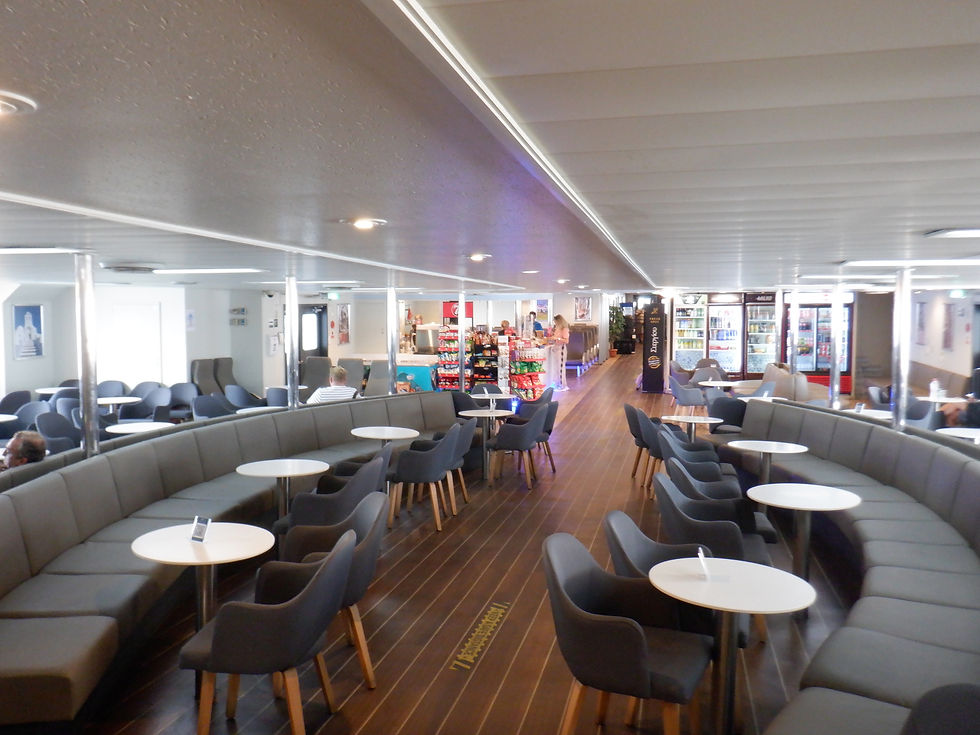
Another view of the indoor lounge area, with the central lounges of the middle section of the ship shown in this pictures. Looking further down, there is a small bar together with numerous vending machines, where passengers can buy coffee, soft drinks, juices and snack.

Heading towards the front section of the indoor lounge area, there is another set of aircraft-style seats looking towards the ship's windows, although the area itself is slightly dark (although this is also due to the curtains covering the windows).

After having seen the indoor area in the lower deck of the accommodation superstructure, I headed back outside in order to explore the outdoor areas of the ship. Walking back towards the aft section, there is a blue staircase on the port side, that leads passengers to the upper deck of the accommodation superstructure.

At the aft section of the upper deck of the accommodation superstructure, there is a wide outdoor sun deck area, featuring several rows of blue plastic chairs attached to the ground and facing towards all directions where one can look at the sea.

After passing by the outdoor sun deck area, I began walking into the outdoor alley found on the port side of the upper deck of the accommodation superstructure, which leads from the aft section to the aft section. Next to it are the crew cabins, which are located right behind the bridge.

Here is a view of the alley in the upper deck of the accommodation superstructure, but as seen from the starboard side.

Walking all the way towards the front section from either outdoor alley in the upper deck of the accommodation superstructure enables passengers to be at the outdoor front section balcony of the ship, thus allowing them to have a great view of the ship's surroundings. The ship's mooring equipment and bow can also be seen as well.

Going back to the aft section, there is an additional open deck area that is located in the upper deck of the accommodation superstructure, right behind the outdoor sun deck area. There, a small alley enables passengers to walk right in front of the ship's funnel and a few solar panels covering the lower deck. It also features a large sign showing that the vessel is powered by these solar panels, while also showing the mechanics of the power generation and its advantages. The whole script is in Japanese, as it was added back when the ship was still under Nankai Ferry (whose name is mentioned at the fourth table on the right). Very interestingly, Kerkyra Seaways decided to keep this sign despite her no longer operating in Japan. This is one of the rare cases where Japanese-built ships which then go on to operate in Greece still display items and signs dating from their stints in Japan.

A view of the solar panels located behind the outdoor sun deck area, together with the ship's aft mast and her funnel, which is located on the starboard side.

A view of the ship's funnel, which features the logo of Kerkyra Seaways against a red background. As it was just mentioned, it is located on the starboard side. This is a typical feature for smaller Japanese-built conventional ferries that were built between the 1980s and the early 2000s. Many of these ships that would go on to be acquired by Greek companies would subsequently acquire a second 'dummy' funnel at the opposite side, in order not to make the funnel appear like it was misplaced (as most ferries operating in Greece that only have a single funnel would usually have it located at the central point of their beam) and to have the ship appear symmetrical aesthetically. This has been the case with conventional ferries such as the MARE DI LEVANTE of Levante Ferries, the DIONISIOS SOLOMOS of Zante Ferries, the EKATERINI P of Fast Ferries, (which used to operate on the Igoumenitsa-Corfu line from 1999 until 2011), or even the THEOLOGOS P of Fast Ferries. In this case, Kerkyra Seaways decided not to add such a funnel, and just leave the single funnel on its own on the starboard side.

In addition to the upper deck of the accommodation superstructure, there is another deck located right above which has an open area with significantly more space. It is located right behind the ship's bridge and foremast.

Having seen explored the indoor areas and the outdoor areas of the HERMES, I was then able to see several other ships that were also docked in Igoumenitsa. One of them was the cruiseferry OLYMPIC CHAMPION of ANEK Lines, which was found in the Eastern part of the port (which is used by ships that operate between Greece and Italy). Built in 2000 in Norway, she has so far spent her entire career under ANEK Lines, having also been the company's former flagship from 2000 to 2008.

A view of the OLYMPIC CHAMPION in the port of Igoumenitsa, where she was resting. She was ordered by ANEK Lines in 1998, back when the Adriatic Sea was experiencing a major transformation as part of the various developments that were being undertaken there in terms passenger and freight transportation between Greece and Italy. Companies like Superfast Ferries, Minoan Lines and Strintzis Lines (the predecessors of Blue Star Ferries) had deployed several newly-built and extremely fast cruiseferries, thus providing much competition against several established companies on the area. ANEK Lines, which had previously deployed the then-newly-built cruiseferry EL. VENIZELOS on the Patras-Igoumenitsa-Corfu-Ancona-Trieste line in 1992, decided to respond by making various acquisitions of large and impressive cruiseferries. Among them was ordering of the OLYMPIC CHAMPION and of her sister ship, namely the HELLENIC SPIRIT, which was delivered in 2001. Both ships were introduced on the Patras-Igoumenitsa-Corfu-Ancona line, and they have met much acclaim, being among the top ships of the Adriatic Sea for two decades.

Not far from the OLYMPIC CHAMPION was another ship linking Greece with Italy, namely the Ro-Pax ferry FLORENCIA of the Italian company Grimaldi Lines. Built in 2004 in Italy, she operates for her company on the Igoumenitsa-Ancona line, thus competing against the OLYMPIC CHAMPION.

Two ships operating on the Greece-Italy service on the Adriatic Sea seen together in Igoumenitsa. These are the FLORENCIA and the OLYMPIC CHAMPION.

Another view of the great OLYMPIC CHAMPION while she was docked in Igoumenitsa. When she was delivered to ANEK Lines in late 2000, she briefly operated on the company's domestic flagship service, namely on the Piraeus-Chania line. She then moved to the Adriatic Sea, where she has spent the bulk of her career. She has since occasionally operated on the Aegean Sea many times, having been called to operate in Crete whenever ANEK Lines felt that they were being threatened by the arrival of new competitors. This was the case in late 2007, when Hellenic Seaways deployed its large and recently-converted Japanese-built ferry, namely the ARIADNE, on the Piraeus-Chania line. The OLYMPIC CHAMPION was therefore sent to compete against her, and ultimately Hellenic Seaways left the service by the start of 2008. Additionally, the ship was deployed on the Piraeus-Heraklion line from 2011 to 2013, during the first years of the ANEK-Attica Group joint venture, which had been established between the said companies in 2011 in order to better compete against Minoan Lines. The OLYMPIC CHAMPION was then sent back to the Piraeus-Chania line during the 2014 season, before eventually moving back to the Adriatic Sea in 2015, having been once again deployed on the Patras-Igoumenitsa-Corfu-Ancona line together with the HELLENIC SPIRIT. Both ships have remained on this service together ever since.

While looking at the other side of the port of Igoumenitsa, I was able to spot three landing craft that operate in Corfu. Two of these were fleetmate of the HERMES, namely the ELENI and the AGIA EIRINI (which were previously operating for Gerontakis Shipping), along with the LEUKIMMI of Sarris Lines.

A view of the LEUKIMMI while she is docked in Igoumenitsa. She was built in 2003 in Greece, and she has since spent her entire career so far linking Igoumenitsa with the port of Lefkimmi in Souther Corfu. She is one of the three landing craft that perform this service, together with the two ships of Lefkimmi Lines, namely the IOANNIS KAPODISTRIAS and the AGIA TRIADA.

Behind the HERMES was another prominent ship that operated on the Igoumenitsa-Corfu line. Indeed, this was the double-ended ferry ANO CHORA II of 2way Ferries. Built in 2004 in Greece, she spent her debut season on the Rion-Antirrion line, before moving to the Igoumenitsa-Corfu line in 2005. She is considered to be one of the best ships operating in Corfu.

Another view of the OLYMPIC CHAMPION as she was resting in Igoumenitsa. I have traveled with her four times in my life, having sailed with her from Ancona to Patras in 2007, twice in 2008 (while traveling in both directions), and then from Patras to Ancona a decade later, namely on 25-26 August 2018. Before arriving in Igoumenitsa for my trip with the HERMES, the last time that I had seen the port was when I had stopped there during my fourth trip with the OLYMPIC CHAMPION back in 2018. This was therefore my first appearance in the port after four years, and it was nice to be able to see the very same ship that had taken me there the last time that I seen it.

Another view of the LEUKIMMI, which is the only active conventional ferry of Sarris Lines. They also own the RENA S II, which had been operating for them from 1982 to 2020, before she was laid-up during that year in Salamina. That ship was previously operating on Corfu-Sarandë line from 2013 until 2019, under the Sarris Cruises brandname. Her future remains uncertain ever since she was laid-up.

The LEUKIMMI seen once again in Igoumenitsa. Despite being the ship with the most experience on the service between Igoumenitsa and the port of Lefkimmi in Southern Corfu, she remains the youngest one operating there, as the AGIA TRIADA and the IOANNIS KAPODISTRIAS were built in 1993 and in 1999, respectively. However, they began service in Corfu later on during their careers, being deployed there in 2008 and in 2018, respectively.

The OLYMPIC CHAMPION seen once again in Igoumenitsa. She continues to provide service to Ancona under the ANEK-Attica Group joint venture, together with the HELLENIC SPIRIT and the SUPERFAST XI of Superfast Ferries.
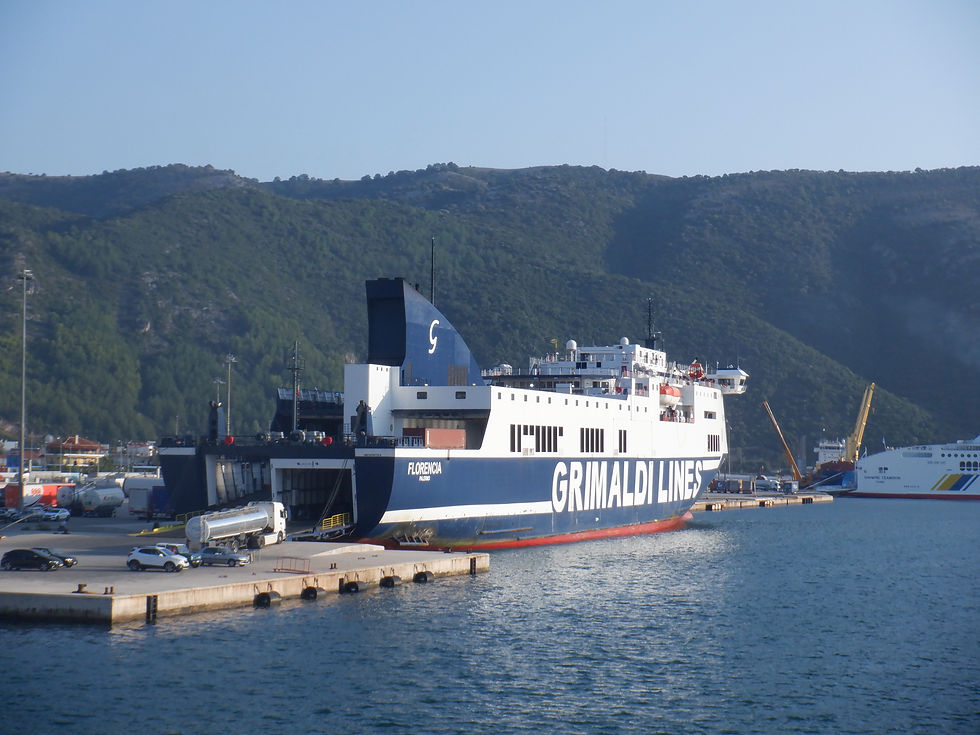
Another view of the FLORENCIA while she is also docked in Igoumenitsa. She has been operating on the Igoumenitsa-Ancona line since 2021, and she performs this service in tandem with her fleetmate and sister ship, namely the VENEZIA. The latter ship would also operate in Corfu during the summer, thus operating on the Igoumenitsa-Corfu-Ancona line.

Another view of the FLORENCIA together with the OLYMPIC CHAMPION in Igoumenitsa. The Italian ferry was built in the well-known shipyard of Cantiere Navale di Visentini, which is located near Venice. She belongs to the prominent Vinsentini-class of Ro-Pax ferries built since the early 2000s. One such ship also used to operate for ANEK Lines. Indeed, this was the ASTERION, which had been deployed on the Patras-Igoumenitsa-Venice line from 2016 to 2018. She then joined the French company Brittany Ferries in order to begin service as the CONNEMARA on the Channel and on the Bay of Biscay, although she has recently been sold to the New Zealand-based company Bluebridge (also known as StraitNZ), for whom she is due to operate on the Cook Strait.

Towards 18:45, the HERMES began to leave Igoumenitsa. Here was another picture showing the ELENI, the AGIA EIRINI and the LEUKIMMI.

Another view of the ANO CHORA II as we were leaving her behind. She is the only ship of 2way Ferries that has remained on the Igoumenitsa-Corfu line, with the other ones operating on the Saronic Gulf and also on the Agia Marina-Nea Styra line on the Petalioi Gulf. The company operates under the Kerkyra Ferries joint venture together with Kerkyra Lines.

Upon departing Igoumenitsa, I noticed another landing craft that was seen arriving from Corfu. Indeed, this was the KERKYRA of Kerkyra Lines.

The KERKYRA seen as she is arriving in Igoumenitsa. Built in 1993 in Greece, she was acquired by Kerkyra Lines in 2012. She was deployed on the Igoumenitsa-Corfu-Paxoi line, while since 2020 she has been operating exclusively on the Igoumenitsa-Corfu line.

Another view of the KERKYRA, which is currently the second-longest serving ship of the current fleet of Kerkyra Lines, after the conventional ferry AGIA THEODORA. She is also the most experienced landing craft out of the three which are owned by the company.

The KERKYRA seen once more as she arrives in Igoumenitsa, while the HERMES is leaving.

The KERKYRA seen while heading towards her docking spot in Igoumenitsa. Before joining Kerkyra Lines, she was previously known as the THASSOS V, having been owned by the Greek company ANETH Ferries from 1996 to 2012. During her stint under the latter, she operated on the Kavala-Thassos line. During the first three years of her career, from 1993 to 1996, she began service as the AVRA for the now-defunct Greek company Avra NE on the Aegion-Agios Nikolaos Phokidos line on the Corinthian Gulf.

Another view of the KERKYRA while she makes her way towards her docking spot in Igoumenitsa. This was her eleventh season under Kerkyra Lines.

Another view of the KERKYRA as we are passing by her on the Igoumenitsa Gulf. She is the second landing craft to have been acquired by Kerkyra Lines, with the first one having been the similarly-named KERKIRA. The latter was the company's first ship upon their establishment in 1984, and she operated for them for 19 years on the Igoumenitsa-Corfu line. In 2003, under a new ownership, she moved to the Rion-Antirrion line, while in 2005 she was sold to Evoïkos Lines, for whom she began service on the North Evoian Gulf as the KLIO, first on the Arkitsa-Aidipsos line and then on the Glyfa-Agiokampos line from 2008 to 2012. During that same year, she operated on the Elefsina-Tinos-Mykonos-Santorini-Rethymnon line, while in 2013 she was sold to the Chilean company Naviera Paredes. She still operates in Chile as the KLIO on the Puerto Montt-Caleta Gonzalo-Chaitén-Quellón line on the Corcovado Gulf.
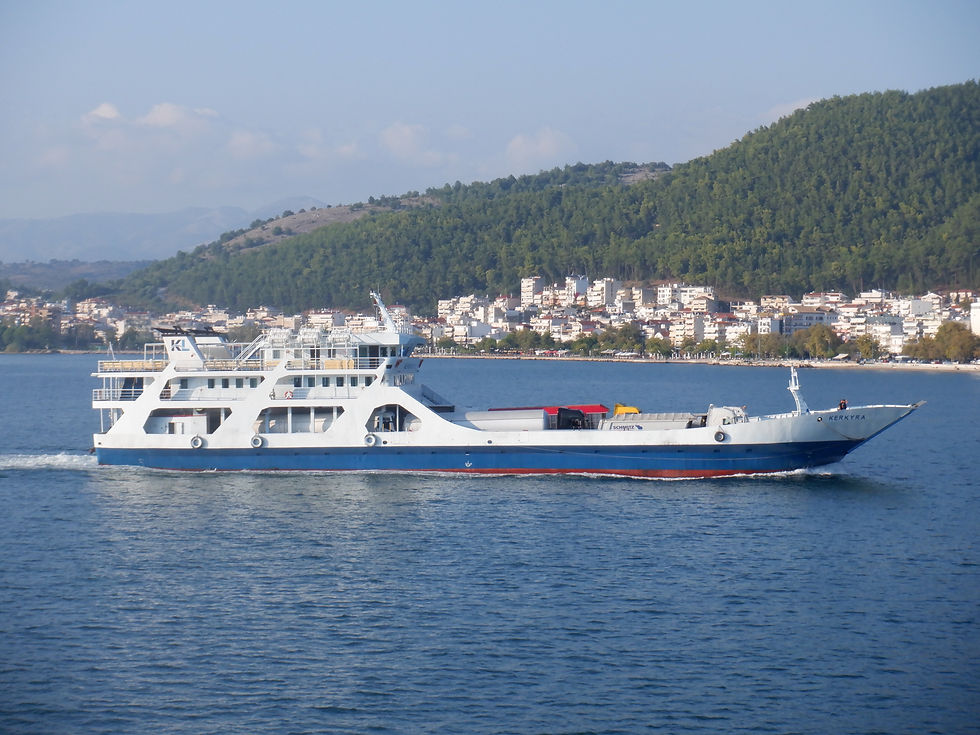
Crossing the KERKYRA on the Igoumenitsa Gulf, as she is arriving in Igoumenitsa.

The KERKYRA seen once more, as she heads towards her docking spot in Igoumenitsa.

The KERKYRA seen while she is arriving in Igoumenitsa, just as we are leaving in order to head to Corfu.

One more view of the KERKYRA while she is heading to Igoumenitsa in order to dock there.

The FLORENCIA seen as we leave Igoumenitsa. She is a ship that has operated on the Adriatic Sea on several occasions, having first started operations there in 2012, when she was the first ship of Grimaldi Lines to begin service on the Patras-Igoumenitsa-Brindisi line. She remained just one season there, as in 2013 she was chartered to the Italian company Grandi Navi Veloci for two years, but she eventually returned there in 2018. She stayed there until 2020, while in 2021 she moved to the Igoumenitsa-Ancona line.

The FLORENCIA seen once more in Igoumenitsa. Before she was acquired by Grimaldi Lines in 2007, she had spent the start of her career under the now-defunct Italian company Lloyd Sardegna, for whom she operated on the Piombino-Olbia line on the Tyrrhenian Sea as the GOLFO ARANCI. Upon joining Grimaldi Lines and being renamed FLORENCIA, she spent two seasons on the Livorno-Porto Vecchio line, thus linking mainland Italy with Corsica. In 2009 she began operating on the Livorno-Barcelona-Valencia line until she had her first stint on the Adriatic Sea. She then joined Grandi Navi Veloci under charter in 2013, and she spent two years back on the Tyrrhenian Sea as she operated on the Civitavecchia-Termini Imerese line. In 2015 she returned to Grimaldi Lines and she was deployed on the Savona-Barcelona line, before being chartered to another Italian company, namely TTT Lines, the following year. With that company, she operated on the Naples-Catania line until 2018, when she once again returned to Grimaldi Lines in order to make her comeback on the Adriatic Sea where she continues to operate to this day.

The OLYMPIC CHAMPION seen once more, during what was her eighth consecutive season on the Patras-Igoumenitsa-Corfu-Ancona line.

The OLYMPIC CHAMPION seen once again, as she remains in Igoumenitsa, where she would stay before eventually heading to Corfu and then to Ancona.

The OLYMPIC CHAMPION spotted once again in Igoumenitsa, as the HERMES is leaving the port.

One last view of the OLYMPIC CHAMPION while she is docked in Igoumenitsa.

After having exited the Igoumenitsa Gulf, we began to make our way towards Corfu, with the HERMES sailing at her usually high speed levels. In the middle of the Ionian Sea, I got to spot another landing craft of Kerkyra Lines, namely the ALKINOOS. She was seen heading from Corfu to Igoumenitsa.

The ALKINOOS seen as she heads from Corfu to Igoumenitsa. Built in 2002 in Greece, she was previously known as the AMALTHEIA of Evoïkos Lines, for whom she operated for the first 15 years of her career. She was sold in 2017 to Kerkyra Lines, which she joined with her longtime fleetmate, namely the landing craft OSIOS DAVID, and the two ships were renamed ALKINOOS and MENEKRATIS, respectively.

The ALKINOOS seen heading to Igoumenitsa, during her her sixth season with Kerkyra Lines.

The ALKINOOS seen as she sails on the Ionian Sea during the early evening.

Crossing the ALKINOOS as she is seen sailing towards Igoumenitsa.

The ALKINOOS seen making her way towards Igoumenitsa. Back when she was owned by Evoïkos Lines, she operated on the North Evoian Gulf, serving the Arkitsa-Aidipsos line from 2002 to 2013, and then the Glyfa-Agiokampos line from 2013 to 2016. That same year, she would also perform occasional trips on the Agios Konstantinos-Skiathos line in order to transport additional trucks on the Sporades. This was something that the ex-OSIOS DAVID used to do until 2015, but in 2016 she operated on the Saronic Gulf, having been deployed the Piraeus-Northern Aegina line (serving the ports of Souvala and Agia Marina) for her final season with Evoïkos Lines.

The ALKINOOS seen once more as she heads to Igoumenitsa. After having been a much-acclaimed ship on the North Evoian Gulf, she has also become a reliable ship on the demanding Igoumenitsa-Corfu line.

After 45 minutes of sailing, I noticed the start of the sunset over the Ionian Sea. I also got to see the Southern part of Corfu from afar.

Another view of the sunset over the Ionian Sea, as we continued to approach the island of Corfu.

Another even more impressive view of the sunset over Corfu and the Ionian Sea.

Towards 19:50, the HERMES had already arrived near the town of Corfu, where the island's main port is located. There, we were greeted by the famous Old Fortress of Corfu, which was built originally on the 6th century before being eventually rebuilt in its current form during the Venetian control of the island. The fortress became a point of reference for Corfu and became widely known for its success in repulsing all three major sieges that were carried by the former Ottoman Empire on the island between 1537 and 1716.

The Old Fortress Corfu seen after having passed in front of it, as we continued to make our way towards the port of Corfu.

As we sailed past the Old Fortress of Corfu, we kept on proceeding along the coastline of the town of Corfu. I was therefore being greeted by a wonderful scenery, as the town is known for its beautiful architecture and colourful buildings inspired by the Venetian era as well as the traditional landscape of the Greek islands located on the Ionian Sea.

Another view of the Old Fortress of Corfu, with the side facing the port still appearing bright despite the sunset.

Another view of the town of Corfu. Getting to see it while approaching the main port is truly a unique moment, as it gives passengers the opportunity to gain a taste of the town before they even disembark in order to explore the island.

Another view of the picturesque landscape showing the coastline of the town of Corfu, just as we began approaching the main port.

After having been greeted by the beautiful town of Corfu, I was now facing the island's port, which we were about to enter. I got to see numerous ferries and other types of passengers being docked there. The first one that appeared in front of me was the conventional ferry KERKYRA EXPRESS of Kerkyra Lines.

Behind the KERKYRA EXPRESS, I got to see another fleetmate of the HERMES, namely the veteran landing craft NANTI. Built in 1973, she has spent all fifty seasons of her career on the Igoumenitsa-Corfu line. This makes her the first ship in the history of the Greek coastal service to have operated uninterruptedly for five decades on the same service. She is also the ferry with the longest active period of service on the Ionian Sea.
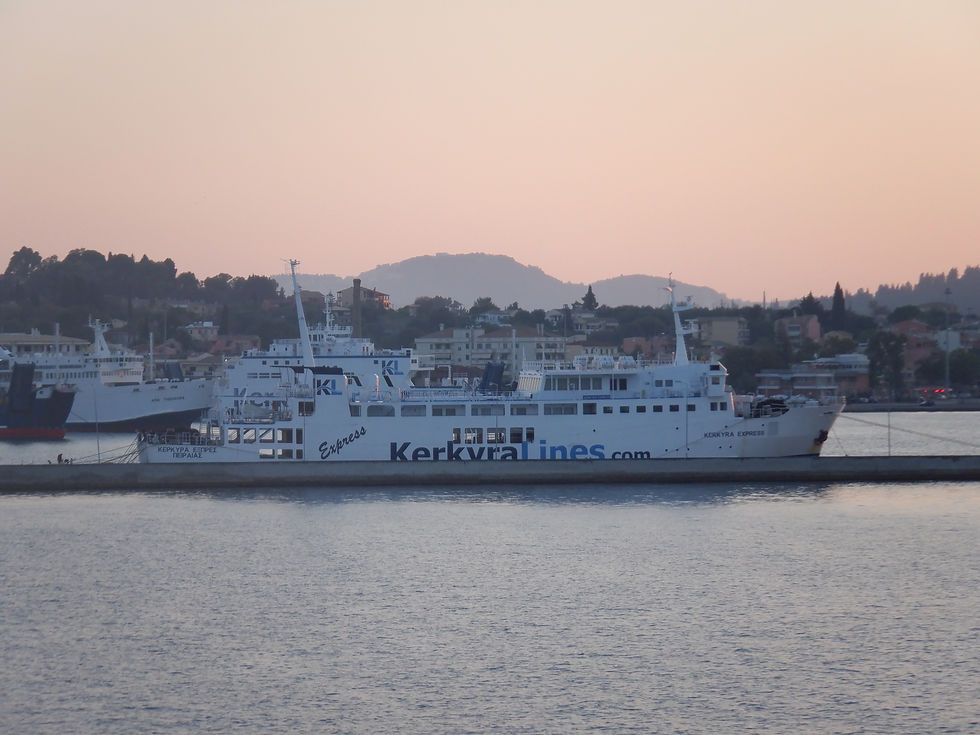
A view of the KERKYRA EXPRESS, which was also built in Japan, just like the HERMES. She began her career there as the NEW HIYAMA for the Japanese company Higashi Nihonkai Ferry (a subsidiary of the larger and more well-known Japanese company Higashi Nihon Ferry), for whom she operated from when she was built in 1991 until 2008. That year, her company was rebranded as Heart Land Ferry. In 2010 she was sold to the Greek company ANENDYK Seaways (then known as ANENDYK Ferries), and she was renamed SFAKIA I. That company was founded in 1982, and it has been providing regular services between the ports of Southwestern Crete and Gavdos through small passenger ships as well as landing craft. The SFAKIA I eventually became the first-ever conventional ferry of the company, and there were various rumours as to how she was going to be utilised. However, she never got the chance to undergo her conversion under that company, and she instead remained laid-up in Chania. She was stuck there for four years, until she was eventually bought by Kerkyra Lines in 2014. She was renamed KERKYRA EXPRESS and she underwent a conversion in Amaliapolis and in Perama, before eventually beginning service for her current owners in 2015.

A wider view of the entrance of the port of Corfu, showing the NANTI, the front section of the AGIOS SPIRIDON of Kerkyra Seaways, the double-ended ferry IONAS that is also owned by Kerkyra Seaways, along with the KERKYRA EXPRESS.

Another view of the KERKYRA EXPRESS in Corfu, during what was her eighth season under Kerkyra Lines. Up until the 2021 season, she was operating on the Igoumenitsa-Corfu-Paxoi line, but since 2022 her service has been restricted to the Igoumenitsa-Corfu line only. Ever since she began service on the Ionian Sea in 2015, she has been the flagship of Kerkyra Lines.

Looking further down in the port of Corfu, I got the chance to take my first picture of the double-ended ferry CORFU SPIRIT of Kerkyra Lines.

Another view of the CORFU SPIRIT in her namesake port. Built in 1989 in the United Kingdom, she has served Corfu under two different stints in her career, and also under two different companies and two different names. Indeed, from 2012 to 2014, she operated on the Igoumenitsa-Corfu as the DORIEUS for 2way Ferries. She was then sold in 2014 to the Russian company JSC Proekt and she operated for four years as the OLYMPIADA on the Kerch Strait. However, in 2019, against all odds, she returned to Greece, having been bought by Kerkyra Lines in order to make a return to the Igoumenitsa-Corfu line. She was once again renamed DORIEUS and she resumed operations on the Ionian Sea during the 2019 season. In 2022, she underwent an extensive refit in Chalkida, during which her indoor areas were fully renovated and her engines were upgraded. When she was ready to resume operations, she was renamed CORFU SPIRIT and she began service on the Igoumenitsa-Corfu-Paxoi line.

Another view of the KERKYRA EXPRESS while she is resting in Corfu. Before the arrival of the HERMES, she was one of the two conventional ferries operating on the Igoumenitsa-Corfu line, together with her fleetmate, namely the AGIA THEODORA (which is partly spotted on the right corner of this picture). Additionally, she was also the fastest conventional ferry operating in Corfu until the HERMES began her service in 2021. Note the 'Express' banner that is displayed behind her company's name and just underneath the funnel on her starboard side.

A view of the IONAS, which is a fleetmate of the HERMES as they are both owned by Kerkyra Seaways. Built in 1989 in the United Kingdom as well, she is a sister ship of the CORFU SPIRIT. In fact, both double-ended ferries have had a near-identical career path, despite having changed owners and countries of operations numerous times throughout their history. Ultimately, both of them found themselves operating in Corfu. Just like the CORFU SPIRIT, the IONAS also initially operated on the Igoumenitsa-Corfu line under 2way Ferries, having started service for them in 2014. However, her stint there lasted only one month, as she was also deployed on the Kerch Strait alongside the CORFU SPIRIT (then known as the DORIEUS) during the 2014 season, although she was actually on charter (as opposed to her sister ship which had been sold and renamed) and performing this service for a different operator, namely Kerch Ferry State Shipping Company. She then headed for two years in Estonia, having been chartered to the Estonian company Saaremaa Laevakompanii. She made her comeback in Corfu in 2017, although instead of operating again for 2way Ferries, she was instead acquired by Kerkyra Seaways (then still known as S&L Ferries). She was deployed on the Igoumenitsa-Corfu-Paxoi line, being joined by her sister ship once more in Corfu (as stated above) two years later.

The IONAS seen together with the AGIA THEODORA in Corfu. Both ships were built one year apart from each other, although they had completely different career paths until they arrived in Greece. Both of them operate on the Igoumenitsa-Corfu-Paxoi line.

Another view of the IONAS, during what was her sixth consecutive season operating on the Igoumenitsa-Corfu-Paxoi line and for Kerkyra Seaways (including when the company was still known as S&L Ferries).

The KERKYRA EXPRESS as we are passing in front of her in order to enter the port of Corfu.

Another view of the KERKYRA EXPRESS as she is seen in Corfu just as we were entering the port. After having spent the first part of her career in Greece under much uncertainty due to never undergoing a refit under her previous company, she has since managed to find a very useful role as one of the main ferries of Corfu, as well as being one of the best ships of Kerkyra Lines.

After having entered the port of Corfu, I was also able to spot three different ships which are all owned by Joy Cruises. These were the small passenger ship JOY STAR, the hydrofoil ILIDA DOLPHIN and the small passenger ship AZIMUT. All three of them link Corfu with Paxoi, while the two small passenger ships also serve the smaller island of Antipaxoi.

Another ship that I got to see was the veteran landing craft GRIGORIS M of GM Shipping. Built in 1967 in Greece, she has been based in Corfu since 2002. She operates on the Igoumenitsa-Corfu-Paxoi-Ereikousa-Othonoi-Mathraki line, whereupon she provides the transportation of goods to Corfu, Paxoi and the Diapontian Islands.

The IONAS seen once more in the port of Corfu. Before she first arrived in Greece in 2012, she operated for the Danish companies VR Shipping (1989-1992) and Scarlett Line (1992-1993), after which she was laid-up for two years in Copenhagen before beginning operations for the Spanish company Flebasa Lines and then the latter's parent company Isnasa (1995-1998). Under all these ownerships in Denmark and Spain, she operated alongside the CORFU SPIRIT, which had joined Isnasa in 1994. Both ships were then laid-up for five years in Algeciras between 1998 and 2003, after which they were both acquired by the Italian company Enermar Transporti Isole Sarde. Both of them then joined the Italian company Bluvia in 2006, before being acquired in 2012 by 2way Ferries, in order to begin operations on the Igoumenitsa-Corfu line. They both operated on the Kerch Strait in 2014, but after the IONAS headed to Estonia in 2015, this was the first time that one of the two sister ships operated on a service where the other one was not deployed. Since then, both double-ended ferries operate under different owners, although they are both serving the Igoumenitsa-Corfu-Paxoi line.

Another view of the AGIA THEODORA in Corfu. Like the IONAS and the CORFU SPIRIT, she was also built in 1989, albeit in Japan, just like the HERMES and the KERKYRA EXPRESS. She became the third ship to join Kerkyra Lines in their history, in addition to being the second conventional ferry that they bought. She was bought in 1999, and, following a lengthy conversion in Perama, she began service later in that same year on the Igoumenitsa-Corfu-Paxoi line.

A view of the CORFU SPIRIT in her namesake island. As it was mentioned previously, she spent the vast majority of her career alongside the IONAS, having been with her under the same owners in Denmark, Spain, Italy and Greece (only under 2way Ferries). There were some exceptions to this path when she spent the 1992 season under charter to the Danish company Skagen Line before joining Scarlett Line, while in 2004, after being acquired by Enermar Transporti Isole Sarde, she was chartered to another Italian company, namely Navigazione Generale Italiana. She reunited with her sister ship when they both joined Bluvia in 2006.

A view of the AGIA THEODORA together with her fleetmate, namely the CORFU SPIRIT. Both ships also serve the island of Paxoi, being the only ones of their company to do so in 2022.

Another view of the KERKYRA EXPRESS, which remains the fastest ferry of Kerkyra Lines.

A view of the AZIMUT, which I got to see in Corfu for the first time, after having previously seen her in Zakynthos during the summer of 2021. Back then, she was spending her fourth consecutive season on the inter-Ionian service, namely on the Zakynthos-Kefalonia-Ithaca-Meganisi-Lefkada-Paxoi-Corfu line. In 2022, this service was taken over by the small passenger ship LEFKADA PALACE of Seven Islands Cruises, and the AZIMUT returned to the Corfu-Paxoi line, where she had spent her first two seasons under Joy Cruises in 2016 and in 2017.

Two other ships of Joy Cruises, namely the JOY STAR and the ILIDA DOLPHIN, seen together in the port of Corfu.

Another view of the AZIMUT in Corfu. She was built in 2001 in Italy, where she spent the first 15 years of her career. She joined Joy Cruises in 2016, and she has since been operating on the Ionian Sea.

A view of the AGIA THEODORA just as we are passing in front of her in the port of Corfu.

Another view of the AGIOS SPIRIDON, as she was resting in Corfu. She was built in 2001 in Greece, and she used to operate as the THASSOS VI for ANETH Ferries on the Keramoti-Thassos line until 2012, and then on the Kavala-Thassos line until 2015, when she was acquired by S&L Lines, which was rebranded as Kerkyra Seaways in 2019. She was renamed AGIOS SPIRIDON and she has since been operating on the Igoumenitsa-Corfu-Paxoi line. While she has been there for only eight seasons, she has been the longest-serving ship of her company's active fleet.

Another view of the GRIGORIS M, which was seen unloading several trucks in the port of Corfu. Before she began her current role on the Adriatic Sea, she operated on the Oropos-Eretria line on the South Evoian Gulf for 35 years, having been previously owned by Psomas Shipping. In fact, she was their first-ever ship, being known as the ARIS. Since then, her company has operated three other ships throughout its history, with all of them being double-ended ferries. The most recent one is the ARIS IV, which as been their sole ship ever since she began service in 2020 (having replaced her predecessor, namely the ARIS III, which was sold in 2019 to the Italian company Delcomar).

The JOY STAR seen once again in Corfu. She was built in 1993 in Ukraine, and she is one of many small passenger ships belonging to the prominent Yevpatoriya-class (built during the 1980s and the 1990s) that went on to spend their careers in Greece. She has been owned by Joy Cruises since 2018. She began service on the Corfu-Paxoi-Antipaxoi line, where she stayed until 2020. The following year, she had a brief spell on the Rhodes-Tilos-Nisyros-Kos line on the Dodecanese, which had been left without a ship following the sale of the PANAGIA SPILIANI of Kateros Shipping Company to Yemeni interests. Before she operated there, she underwent an extensive conversion in Perama, during which her stern was refitted so that she could load vehicles. This therefore makes her a small ferry. After one season on the Dodecanese, she returned to the Corfu-Paxoi-Antipaxoi line in 2022.

Another view of the ILIDA DOLPHIN, which was one of the two hydrofoils of Joy Cruises during the 2022 season, along with the ILIDA II. The moment that I saw her was very meaningful, as I was able to spot a familiar face for the first time in over a decade. Indeed, this ship was a major presence in Aegina during my childhood, as she was previously known as the FLYING DOLPHIN HERMES of Aegean Flying Dolphins, for whom she operated from 2005 to 2011. During her spell under that company, she was mainly operating on the Piraeus-Aegina-Agistri line on the Saronic Gulf. It was quite special to see her again after so many years, under a different name and a different livery, and far away from Aegina. Moreover, it was a great coincidence to have spotted the FLYING DOLPHIN HERMES for the first time since 2010 while I was traveling with the similarly-named HERMES.

Another view of the ILIDA DOLPHIN in Corfu. Built in 1981 in Georgia (then part of the Soviet Union), she has spent her entire career in Greece. She was originally known as the FLYING DOLPHIN XVI of the once-acclaimed Greek company Ceres Flying Dolphins. She operated on the Sporades, staying there even after her original company was acquired by Minoan Flying Dolphins in 1999 (with the latter being renamed Hellas Flying Dolphins in 2002). In 2005 she was bought by Aegean Flying Dolphins, and she spent two years on the Samos-Patmos-Leipsoi-Leros-Kalymnos-Kos line on the Dodecanese. In late 2006 she was renamed FLYING DOLPHIN HERMES and she moved to the Piraeus-Aegina-Agistri line. In 2011 she was sold to Royal Coastlines Maritime Company, being renamed AEGEAN PRINCE II, and she was once again deployed on the Dodecanese. She was bought by Joy Cruises in 2015, and she has since been operating on the Ionian Sea as the ILIDA DOLPHIN. She has been serving the Corfu-Paxoi line since 2021, having also been there during her first two seasons under Joy Cruises, while from 2017 to 2020 she was operating on the Corfu-Sarandë line.

Another view of the JOY STAR. Just like the ILIDA DOLPHIN, she has also operated on the Saronic Gulf and on the Dodecanese, besides serving Corfu and Paxoi. Indeed, she spent the first six years of her career from 1993 to 1999 on the Zea-Hydra-Poros-Aegina line as a one-day cruise ship as the SARONIC STAR for the now-defunct Greek company Saronic Cruises, while she also operated on the Dodecanese in 2021. Between her spell on the Sarnic Gulf and her acquisition by Joy Cruises, she spent almost two decades on the Patmos-Samos-Kuşadası line as the SAMOS STAR, first under Samos Ships (1999-2010), and then under Samian Cruises (2010-2018). The latter went bankrupt in 2016, after which the ship was laid-up in Siğacık in Turkey for two years, before being eventually reactivated by Joy Cruises as the JOY STAR.

Another view of the bow of the AGIA THEODORA.

The IONAS seen in Corfu once again. Along with the CORFU SPIRIT, she is part of the prominent Superflex-class, which consisted of 15 double-ended ferries that were built between 1987 and 1989 in the United Kingdom (most specifically at the North East Shipbuilders Limited Shipyard in the city of Sunderland). Featuring two garage decks and two ramps in each side, they were introduced on several short-distance services across Europe, and they have served numerous operators throughout the past three decades. Four of them also went on to operate in Greece. And, coincidentally, all of them served Corfu. The first one was the ex-SUPERFLEX FOXTROT, which became the PANTOKRATOR upon joining Kerkyra Seaways (back then trading as Feax Express Lines) in 1996, after having done an impressive conversion into a single-ended conventional ferry. She operated on the Igoumenitsa-Corfu line for 16 years, after which she was sold in 2012 to the Indonesian company Panca Merak Samudera PT. The second one was the ex-SUPERFLEX ALFA, which first operated in Corfu as the NIKOLAOS for Ionion Lines in 2008. She was transferred to Kerkyra Lines in 2018, and since 2019 she has been under charter to the Maltese company Gozo Channel Line, for whom she operates on the Mġarr-Gozo line on the Gozo Channel. The other two ships are the IONAS and the CORFU SPIRIT, which have both operated in Corfu under two different owners.

Another view of the KERKYRA EXPRESS as she remains docked in the port of Corfu.

The KERKYRA EXPRESS seen together with the AGIOS SPIRIDON and the GRIGORIS M.

The CORFU SPIRIT seen as we are passing by her.

Another view of the AGIA THEODORA, while she was docked in Corfu. When she began her career in Japan, she was known as the YUKAZURU MARU of the Japanese company Awaji Ferry Boat. She was operating on the Kobe-Oiso line on the Akashi Strait, together with her three sister ships. One of them, namely the CHIEZURU MARU (built in 1990), would also go on to operate in Greece later in her career, and coincidentally, also on the Igoumenitsa-Corfu line, thus reuniting with the AGIA THEODORA. However, she was not operating for Kerkyra Lines, but for Fast Ferries, which bought her in 2003. The ship underwent a lengthy conversion in Salamina in order to be rebuilt according to the demands of the Greek coastal service, although her aft section differed largely from that of the AGIA THEODORA. She was renamed PLATITERA and she began service on the Igoumenitsa-Corfu line in 2004. She only stayed there for three years, as she was sold in 2007 to the Italian company Medmar, for whom she remains in service today as the MARIA BUONO on the Pozzuoli-Procida-Ischia line on the Naples Gulf.

The AGIA THEODORA, one of the main competitors of the HERMES in Corfu, seen in the latter's port.

A view of the CORFU SPIRIT once again, just as we were passing by her in order to dock next to her.

The CORFU SPIRIT seen in the port of Corfu, during what was her first season under her new name and following her extensive refit in Chalkida.

Next to the area where the HERMES was going to dock, I noticed another small passenger ship based in Corfu, namely the GEORGIA of Sarris Cruises. Built in 1994 in Ukraine, she is another ship belonging to the Yevpatoriya-class, just like the JOY STAR. She has been owned by Sarris Cruises since 1995, and she has been operating on the Corfu-Paxoi-Antipaxoi line since 2020.

Looking further down, I spotted another familiar face for the first time since 2019. Indeed, this was the landing craft MENEKRATIS of Kerkyra Lines, which was previously known as the OSIOS DAVID of Evoïkos Lines. She joined her current owners in 2017, together with the ex-AMALTHEIA, which became the ALKINOOS.

Behind the MENEKRATIS was another small passenger ship, namely the CAPTAIN BILL of Corfu Cruises. Built in 1996 in Greece, she also operates on the Corfu-Paxoi-Antipaxoi line.

Another view of the MENEKRATIS together with the CAPTAIN BILL. The MENEKRATIS was a ship that I got to see in Aegina in two different seasons, most specifically in 2016 and in 2019. On both occasions, she was operating on the Piraeus-Northern Aegina line (serving the port of Souvala). She first operated there in 2016, during her final season with Evoïkos Lines, before joining Kerkyra Lines the following year. She returned to the Saronic Gulf in 2019, having been chartered to the Saronic Ferries joint venture when they launched a new service to the port of Souvala. After the summer ended, she subsequently returned to Kerkyra Lines, for whom she has been operating on the Igoumenitsa-Corfu line ever since.

Another view of the CORFU SPIRIT, just as the HERMES began docking next to her.

A further view of the KERKYRA EXPRESS, as she was still docked in Corfu.

The GRIGORIS M seen once more, with the AGIOS SPIRIDON seen docked right next to her.

Another view of the more modern AGIOS SPIRIDON, together with the older and more experienced landing craft GRIGORIS M.

Another view showing the KERKYRA EXPRESS along with the AGIOS SPIRIDON and the GRIGORIS M.

The CORFU SPIRIT seen once more as she is docked in her namesake port.

While the HERMES was undergoing her maneuvering procedure, I saw another hydrofoil which had entered the port of Corfu. Just like the ILIDA DOLPHIN, it was also a ship that I used to see for many years during my childhood, as she also used to operate in Aegina for many years, and I got to see her for the first time in 12 years. Indeed, this was the SANTA of Ionian Seaways, which is the Albanian subsidiary of Ionian Cruises. She was previously the FLYING DOLPHIN XV of Hellenic Seaways (as well as for that company's predecessors, namely Minoan Flying Dolphins/Hellas Flying Dolphins), for whom she operated from 2005 until the end of the 2011 season. She was then sold to Ionian Cruises, for whom she has since been operating on the Corfu-Sarandë line, thus linking the island with Albania.

Another view of the SANTA, which I remember fondly back when she was operating on the Saronic Gulf as the FLYING DOLPHIN XV. She is a sister ship of the ILIDA DOLPHIN, having also been built in 1981 in Georgia (then part of the Soviet Union). Both ships were delivered to Ceres Flying Dolphins and they began operations for the iconic company on the Sporades. The FLYING DOLPHIN XV was then moved to the Saronic Gulf in 2003 (by which time she was operating for Hellas Flying Dolphins), serving the Piraeus-Aegina-Agistri-Poros-Hydra-Ermioni-Spetses-Porto Cheli line until the summer of 2011, when she spent her final season back on the Sporades. When that year ended, she had completed 30 years of service, meaning she was forced to be withdrawn due to the mandatory retirement that was imposed at the time for Greek hydrofoils reaching that age. As such, she followed the path of several ships of her type by being deployed on Corfu-Sarandë line.

Another view of the SANTA as she heads towards her docking spot in Corfu. Ever since she began service for Ionian Cruises (and subsequently Ionian Seaways), she has been operating under the Albanian flag. In addition to being a ship that I saw very frequently during my childhood, she is notably the first hydrofoil with which I remember traveling, having done so back when she was heading from Piraeus to Aegina during the summer of 2006, while still operating as the FLYING DOLPHIN XV under Hellenic Seaways.

At 20:00, the HERMES had disembarked, thus completing my trip and marking my first-ever arrival in the island of Corfu. Here is another view of the AGIA THEODORA, as seen from the port of the island that she has been serving for the past 24 years.

After the SANTA, there was another hydrofoil operating on the Corfu-Sarandë line (having also been a ship formerly owned by Ceres Flying Dolphins and then by Minoan Flying Dolphins and Hellas Flying Dolphins) that had also entered the port of Corfu. Indeed, this was the KRISTI of the Greek-Albanian company Finikas Lines, which was previously known as the FLYING DOLPHIN VII. Built in 1976 in Georgia (then part of the Soviet Union), she spent her entire career under her original owners on the Saronic Gulf. By the time Hellas Flying Dolphins was rebranded as Hellenic Seaways in 2005, she was laid-up in Perama, before being sold two years later to Finikas Lines.

The KRISTI seen heading towards her docking spot in Corfu. Being one of the first hydrofoils to have ever operated in Greece, she also went on to have a successful second career on the Corfu-Sarandë line, on which many of her former fleetamtes under Ceres Flying Dolphins and then under Minoan Flying Dolphins/Hellas Flying Dolphins went on to operate as well. Her company also owns the ex-FLYING DOLPHIN IV, which operated for Hellenic Seaways until 2009. She joined them in 2012, as the FLYING DOLPHIN HARIKLIA and she was also deployed on the Corfu-Sarandë line, while from 2014 to 2016 she was under charter to Joy Cruises. However, she has been laid-up in Perama since 2018.

Another view of the IONAS, as she was resting in Corfu.

I then got to see the AZIMUT, which was spending her first season on the Corfu-Paxoi line since 2017.

Another view of the AZIMUT in the port of Corfu. Before she began operations on the Ionian Sea for Joy Cruises, she had previously spent the first 15 years of her career in Italy, namely on the La Spezia-Portovenere-Manarola-Corniglia-Vernazza-Monterosso-Levantino line, thus sailing from the Gulf of La Spezia to the Cinque Terre villages on the Ligurian Sea.

One last view of the IONAS as she remains docked in the port of Corfu. There have been various rumours lately regarding the ship's future, as some shipping media outlets have reported that she is close to being sold overseas. So far, there has been no confirmation regarding such a scenario, while no one knows who the interested buyers are and where they are based.

Another view of the ILIDA DOLPHIN, which I got to see for the first time since 2010, back when she was still operating as the FLYING DOLPHIN HERMES under Aegean Flying Dolphins.

Another view of the AZIMUT, whose appearance has been frequently compared to a small yacht or a small passenger ship performing cruises around well-known British, American, or Australian port cities.

One last view of the AZIMUT, during her seventh consecutive season on the Ionian Sea and under Joy Cruises.

Another view of the JOY STAR, including her aft section which has a small garage that enables her to load a select number of vehicles. She is currently operating on the Dodecanese, having returned there for the first time since 2021, as she is temporarily replacing the conventional ferry NISSOS KALYMNOS of ANEK Sea Lines on the largest portion of her lifeline, after that ship was damaged following after she ran aground in the island of Telendos in late 2022. Due to the lengthy time required for her to be repaired, the JOY STAR was chosen to cover the largest part of her services, as she was deployed on the Samos-Agathonisi-Farmakonisi-Arkioi-Patmos-Leipsoi lifeline. She is scheduled to stay there until early March, when the NISSOS KALYMNOS is estimated to return to service.

Another view of the veteran landing craft GRIGORIS M, which was seen unloading several sanitation trucks.

The AGIOS SPIRIDON, which is one of the two former ships of ANETH Ferries that went on to operate in Corfu, together with the KERKYRA.

Another view of the AGIOS SPIRIDON in the port of Corfu. When she joined Kerkyra Seaways (then still trading as S&L Ferries) in 2015, she was acquired through an exchange of ships, upon which ANETH Ferries acquired the landing craft AGIOS PANTELEIMON from the Corfu-based company. That ship still operates on the Kavala-Thassos line ever since.

The AGIOS SPIRIDON seen once again as she is docked next to her fleetmate, namely the NANTI.

Another view of the legendary NANTI, which continues to provide very reliable service in Corfu, as she has done so throughout her five decades of operations.

The NANTI seen once again while she is resting in the port of Corfu.

Another view of the GRIGORIS M in Corfu, as the daylight kept on fading away.

The CORFU SPIRIT seen as well, as she was docked next to the HERMES.

Another closer view of the MENEKRATIS, which I got to see for the first time since 2019, back when she was spending the summer on the Saronic Gulf, under charter to the Saronic Ferries joint venture (which includes Nova Ferries and 2way Ferries). I had also seen her back when she was operating there during the 2016 season (which was her final one under Evoïkos Lines), and also in Igoumenitsa in 2018 (which was her second season under Kerkyra Lines), during my trip with the OLYMPIC CHAMPION.

The HERMES seen in Corfu, after I had just completed my trip with her.

The HERMES seen in Corfu, having finished her final trip of the evening.
This therefore marks the end of a historic trip, which saw me finally arriving in Corfu for the first time in my life. I could not have selected a better ship to take me there, as I was thankful to have had the opportunity to travel onboard the best ship that links the island with Igoumenitsa. While she did not undergo an extensive conversion in the same way Japanese-built ferries that are bought by Greek companies have done over the past few decades, the HERMES remains a very important ship for her company and for Corfu, with her size and speed making her a true standout and a major asset for Kerkyra Seaways. This was undoubtedly a well-planned investment by Kerkyra Seaways, as they sought to bring a ship that would be able to compete successfully against the rapidly-expanding Kerkyra Lines, and which would also be the main driver behind the company's recent rebranding. I was fortunate to not only enjoy this ferry, while also having the chance to spot several ships based in Corfu for the first time, and also several ships that were previously on the Saronic Gulf and which I got to see for the first time in many years. Of course, my stay in Corfu would also see me making several visits to the island's port, which of course meant even more pictures These will be shared in the next post.
#hermes #kerkyraseaways #summer2022 #greece #igoumenitsagulf #ionian #igoumenitsa #corfu #olympicchampion #aneklines #florencia #grimaldilines #eleni #agiaeirini #nanti #agiosspiridon #ionas #leukimmi #sarrislines #anochoraii #2wayferries #kerkyra #alkinoos #kerkyraexpress #corfuspirit #agiatheodora #menekratis #kerkyralines #joystar #ilidadolphin #azimut #joycruises #grigorism #gmshipping #georgia #sarriscrusies #captainbill #corfucruises #santa #ionianseaways #ioniancruises #kristi #finikaslines #tribute


Comments